From artificial intelligence to institutional independence: Santorini summit explores priorities for the future of anti-doping
Representatives from 26 countries gathered in Greece for the 3rd Central and Eastern European Anti-Doping Summit, addressing the 2027 World Anti-Doping Code, responsible AI, athlete rights, operational challenges and institutional independence.
As the global anti-doping community approaches a major regulatory transition, the challenge facing national anti-doping organisations is no longer simply how to comply with international standards, but how to build the institutional capacity, technological readiness and independence needed to implement them effectively.
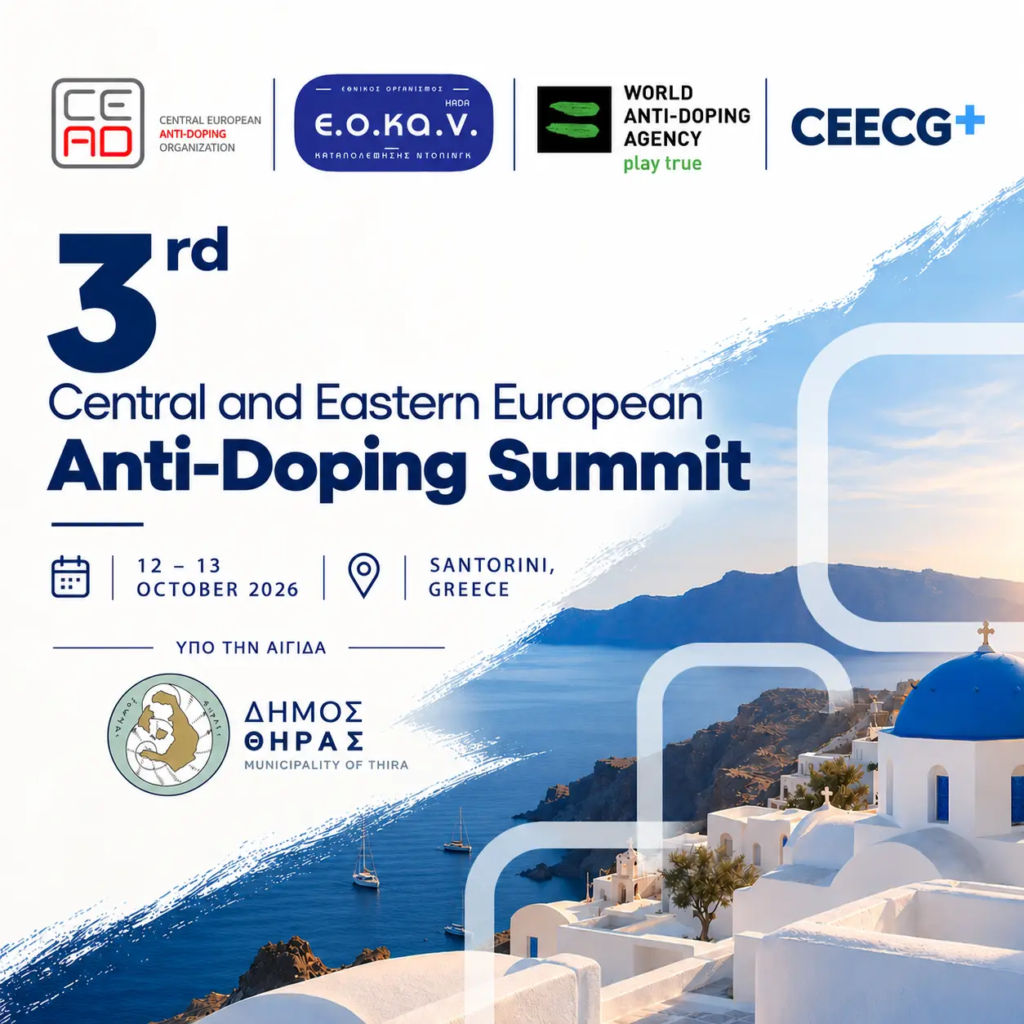
These questions took centre stage at the 3rd Central and Eastern European Anti-Doping Summit, held in Santorini, Greece, from 12 to 14 October 2026.
Hosted by the Hellenic Anti-Doping Agency (EOKAN/HADA), in cooperation with the Central European Anti-Doping Organization (CEADO) and the Polish Anti-Doping Agency (POLADA), the Summit brought together representatives of national anti-doping organisations, the World Anti-Doping Agency (WADA) and partner institutions from 26 countries.
Building on previous editions in Warsaw (2023) and Belgrade (2024), the gathering examined six interconnected dimensions of modern anti-doping governance: regulatory implementation, European funding, artificial intelligence, Therapeutic Use Exemptions and Results Management, digital operational systems, and institutional independence.
Taken together, the discussions revealed a common challenge: how to turn international requirements and emerging innovations into systems that are effective, accountable and worthy of trust.
Preparing for the 2027 Code: beyond formal compliance
With the revised World Anti-Doping Code and International Standards taking effect on 1 January 2027, implementation readiness emerged as a central priority.
The opening panel brought together representatives of Hungary, Austria, Greece and Montenegro, alongside WADA, to examine the challenges of translating the new international framework into national practice.
Discussions highlighted that regulatory harmonisation requires more than the formal adoption of new rules. Effective implementation depends on qualified personnel, operational procedures, training, adequate resources and consistent institutional practices.
Participants also acknowledged the differences in capacity among national anti-doping organisations. While all NADOs must meet the same international requirements, their financial resources, staffing levels and institutional experience vary considerably.
The discussion reinforced the importance of knowledge sharing, mentoring and practical assistance, particularly for smaller and developing organisations. The challenge is not merely to ensure that every organisation follows the same standards, but to ensure that each has the capacity to apply them effectively.
Building stronger organisations through European cooperation
The Summit also examined how European Union funding can strengthen the capacity and sustainability of national anti-doping systems.
A dedicated panel brought together representatives of Poland and Portugal, alongside WADA, the European Education and Culture Executive Agency (EACEA) and the European Observatoire of Sport and Employment (EOSE).
Discussions focused particularly on the opportunities offered by Erasmus+ and other European cooperation instruments to support education, professional development, institutional capacity building and cross-border partnerships.
One important message concerned the design of sustainable projects: cooperation should begin with clearly identified organisational needs rather than the availability of a particular funding opportunity.
Partnerships extending beyond the anti-doping community, including universities, NGOs and public institutions, were identified as valuable mechanisms for bringing additional expertise and strengthening project outcomes.
The broader implication is that organisational resilience cannot be built through regulatory obligations alone. It also requires investment in people, knowledge and long-term institutional capabilities.
Artificial intelligence: innovation must protect athlete rights
One of the Summit’s most forward-looking discussions focused on the role of artificial intelligence in anti-doping.
The panel brought together perspectives from Azerbaijan, Greece and Slovakia, alongside the WADA Athlete Council, reflecting the importance of combining operational, legal, institutional and athlete perspectives.
Discussions explored the potential applications of AI in data analysis, test planning, risk assessment, education and the provision of information to athletes about their rights and responsibilities.
Dr Tahmina Taghi-zada, CEO of the Azerbaijan National Anti-Doping Agency (AMADA), highlighted how artificial intelligence could support risk-based test planning by analysing historical testing data, identifying gaps in testing coverage and supporting more effective allocation of resources, alongside its potential applications in investigations and education.
However, the opportunities offered by AI were considered alongside fundamental questions concerning privacy, data protection, transparency and athlete rights.
Particular attention was given to the need for meaningful human oversight whenever AI-assisted processes may affect athletes’ rights.
The discussion reinforced a fundamental principle: artificial intelligence can support decision-making, but it cannot replace human responsibility and accountability.
For sport integrity governance, this distinction is particularly important. The value of technological innovation cannot be measured solely through efficiency or analytical capabilities. It must also be assessed through its implications for fairness, transparency, due process and public trust.
Therapeutic Use Exemptions and Results Management: ensuring consistent application
Another panel examined changes affecting Therapeutic Use Exemptions (TUEs) and Results Management under the 2027 regulatory framework.
The discussion brought together representatives of Greece, Poland and Bulgaria, alongside WADA, combining national disciplinary experience with international regulatory expertise.
Participants examined new deadlines, provisional suspensions, retroactive TUEs and measures intended to improve the efficiency of Results Management proceedings.
Particular attention was given to ensuring that comparable cases are handled consistently across different jurisdictions.
The importance of well-reasoned disciplinary decisions, access to anonymised case law and regular exchanges between disciplinary bodies was highlighted as essential to strengthening legal certainty and fairness.
The discussions demonstrated that a common regulatory framework cannot, by itself, guarantee consistent outcomes. Its credibility ultimately depends on the fairness, quality and consistency of its implementation.
Digital transformation: addressing the operational realities of ADAMS and DCO Central
Digitalisation and its practical implications formed another central theme of the Summit.
Representatives of Romania, Austria and the Czech Republic, together with WADA, examined the operational challenges associated with the Anti-Doping Administration and Management System (ADAMS) and DCO Central.
The panel addressed issues experienced by anti-doping organisations and Doping Control Officers, including system stability, data synchronisation, manual corrections and the reliability of electronic documentation during testing procedures.
Participants highlighted the importance of ensuring that information collected during doping controls is accurately recorded, securely stored and correctly transferred between systems.
Even when a doping control is conducted properly, technical failures or documentation inconsistencies can create additional operational difficulties.
The discussion reinforced a practical priority: digitalisation must improve the quality, reliability and efficiency of anti-doping operations rather than introduce new technical burdens.
More broadly, the session illustrated that technological transformation is not simply about adopting digital tools. It also requires reliable infrastructure, appropriate procedures and accountability for the integrity of information.
Independence and trust: the institutional foundations of clean sport
Beyond regulatory reform and technological innovation, the independence of national anti-doping organisations emerged as a recurring concern throughout the Summit.
The concluding panel brought together representatives of Austria, Slovakia, Poland and Georgia, alongside WADA, to examine the wider international anti-doping environment.
Discussions addressed political influence, institutional autonomy, compliance responsibilities and the importance of trust in the global anti-doping system.
Hubert Dziudzik, Interim Director of POLADA, emphasised that anti-doping must not become an instrument of political influence or government interests, while highlighting the importance of regional cooperation and collective problem-solving.
The panel also examined Recommendation 19 from the report of WADA’s Working Group on National Anti-Doping Organizations Operational Independence (WGOI), concerning independence in testing at major sporting events and the related operational and financial considerations.
Participants recognised the importance of strengthening cooperation between NADOs, including through mentoring, shared expertise and coordinated approaches to common challenges.
The discussions illustrated that effective anti-doping governance depends not only on international harmonisation, but also on institutions capable of exercising their responsibilities independently, consistently and transparently.
From dialogue to collective progress
The Summit concluded with the presentation of the Statement of the Summit Participants by CEADO Chair Michael Cepic, followed by closing remarks from HADA Governor Dr Grigorios Leon.
Across all six panels, a common message emerged: the future effectiveness of anti-doping will depend not only on stronger rules and increasingly sophisticated technologies, but also on the institutions, people and partnerships responsible for putting them into practice.
The Santorini gathering demonstrated the continuing relevance of regional cooperation in addressing practical challenges, sharing experience and strengthening the capacity of national anti-doping organisations.
Yet the issues raised during the Summit also point to questions that extend beyond anti-doping itself.
What it means for IPSEI: connecting the wider sport integrity agenda
From the perspective of the International Platform for Sport Ethics & Integrity (IPSEI), the significance of the Santorini Summit extends beyond preparations for the 2027 World Anti-Doping Code.
The six discussions demonstrated how different dimensions of sport integrity are increasingly interconnected, creating valuable opportunities for knowledge exchange, institutional cooperation and interdisciplinary dialogue.
The continued development of international anti-doping standards, supported by WADA and its stakeholders, provides an important framework for strengthening clean sport worldwide. Regional initiatives such as the Santorini Summit complement these efforts by facilitating practical exchanges, sharing experiences and supporting national organisations in implementing internationally agreed requirements.
The discussions also highlighted several issues of relevance to the wider sport integrity community.
Effective implementation of international standards depends on professional expertise, institutional capacity and continued cooperation between national and international stakeholders.
Responsible technological innovation offers new opportunities to strengthen sport integrity, particularly when accompanied by appropriate safeguards for transparency, data protection, human oversight and athlete rights.
Institutional independence and good governance remain essential principles for maintaining credibility, ensuring impartial decision-making and strengthening confidence in sport integrity institutions.
International cooperation and knowledge sharing can help organisations exchange good practices, build professional capacity and develop practical responses to common challenges.
For IPSEI, these themes reflect the importance of connecting expertise across anti-doping, competition manipulation, safeguarding, athlete welfare and sport governance.
The platform seeks to contribute to this broader international conversation by facilitating the exchange of knowledge, highlighting innovative approaches and encouraging dialogue between professionals and institutions working to protect sport.
The future of sport integrity will be strengthened through internationally recognised standards, responsible innovation, institutional cooperation and a shared commitment to trust.
For IPSEI, making integrity connected means supporting that shared commitment across disciplines, institutions and borders.



Thank you for your rating!
Share your thoughts