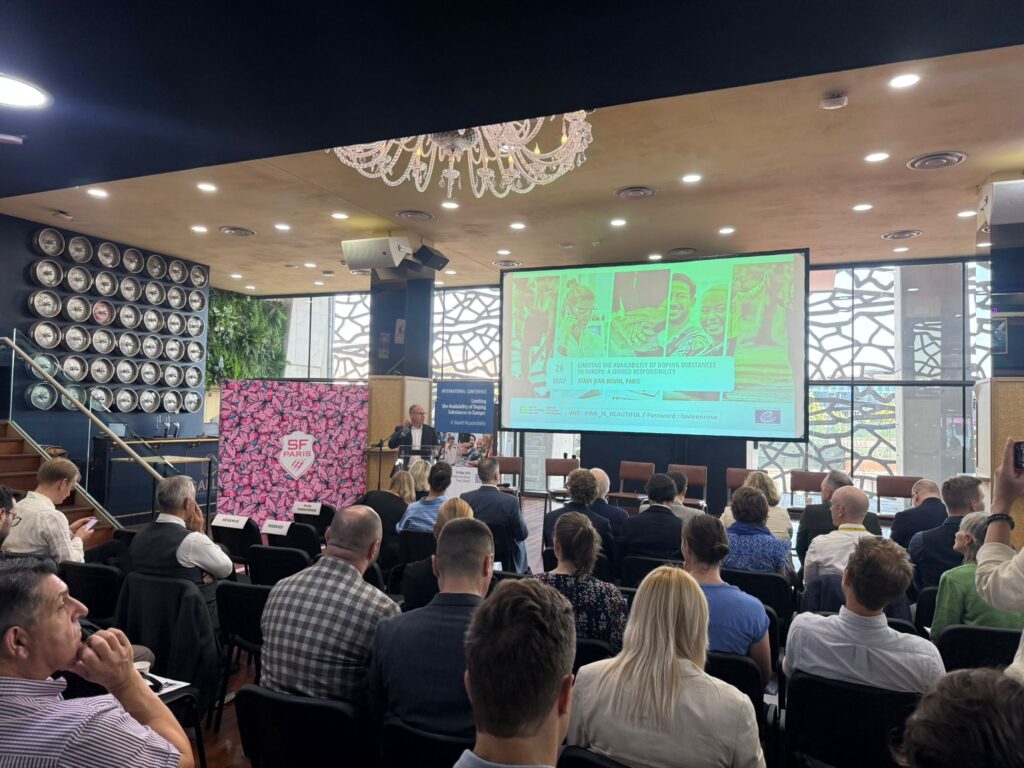
Paris conference calls for broader action on doping substance availability
The availability of doping substances is no longer only a question for elite sport. It is becoming a wider public health, consumer safety and governance challenge.
That was the central message of the international conference “Limiting the Availability of Doping Substances in Europe: A Shared Responsibility,” held at Stade Jean Bouin in Paris and organised by the Council of Europe with the support of the World Anti-Doping Agency (WADA).
The event brought together around 130 participants from public authorities, anti-doping organisations, sport bodies, law enforcement, the pharmaceutical sector and international organisations. The focus was clear: Europe needs a more coordinated response to the growing availability and use of performance- and image-enhancing substances, particularly beyond elite sport.
For many years, doping has been discussed mainly through the language of competition — athletes, testing, results, violations and sanctions. That remains essential. But the debate is now moving into a broader space.
Performance- and image-enhancing substances are increasingly visible in gyms, recreational sport, online markets and social media-driven fitness cultures. They are often promoted not as “doping”, but as shortcuts to appearance, confidence, strength or rapid physical transformation.
This shift creates a difficult challenge. Many users may not see themselves as athletes. They may not be reached by traditional anti-doping education. Yet they may still be exposed to products that are illicit, falsified, substandard, contaminated, wrongly labelled or sold without reliable information about their effects.
The health risks are therefore no longer limited to the world of organised sport. They can affect young people, recreational athletes, gym users and ordinary consumers drawn into a fast-moving market of enhancement products.
The Paris conference reflected this wider reality. Discussions addressed the current situation of access to doping substances in Europe, public health concerns, law enforcement challenges, the role of pharmaceutical regulation, cross-border cooperation and the need for stronger coordination between institutions.
A strong emphasis was placed on the environments that shape demand. Social media, body-image pressure, online coaching, anonymous purchasing and the normalisation of “shortcut” culture are changing how enhancement products are perceived. In these spaces, the promise of quick results can travel faster than the warning about long-term harm.
The conference also looked at the supply side. Doping substances do not reach users through one route only. They may move through online platforms, informal networks, supplement markets, postal routes, payment systems and criminal supply chains. Each stage may fall under a different authority. Each gap can weaken the overall response.
This is why the event moved beyond a narrow anti-doping discussion. It framed the issue as a shared responsibility involving sport, health, medicines regulation, customs, police, prosecutors, laboratories, digital actors and international organisations.
In the afternoon, participants worked in four interactive workshops: Demand Reduction & Awareness, Quality & Supply Control and Health Protection, Detection & Law Enforcement, and Coordination & Governance.
Together, these themes formed a full-chain approach. Reducing demand is not enough if dangerous products remain easy to buy. Controlling supply is not enough if misleading promotion continues. Law enforcement cannot act effectively without timely information. Anti-doping organisations cannot carry the responsibility alone.
The Azerbaijan National Anti-Doping Agency (AMADA) was represented at management and senior expert level. The delegation included Dr. Tahmina Taghi-zada, Chief Executive Officer of AMADA, Dr. Rufat Efendiyev, Deputy Chief Executive Officer of AMADA, and Nijat Amiraslanli, Head of the Results Management and Investigations Department.
AMADA representatives participated in the Coordination & Governance workshop, which focused on how national authorities can strengthen cooperation, improve information-sharing, mobilise resources and periodically review national frameworks designed to limit the availability of doping substances.
Dr. Efendiyev served as rapporteur for the Coordination & Governance workshop.
The governance discussion was one of the most important elements of the conference. A doping substance may be produced in one place, promoted online in another, sold through a digital platform, delivered across borders and used in a recreational setting. If harm occurs, it may appear first in a health system rather than in a sport investigation.
No single institution can see the whole chain alone.
That is why the key question is not only who is responsible, but how responsibilities connect in practice. National Anti-Doping Organisations remain central to clean sport, but the wider availability of doping substances requires the active involvement of medicines regulators, customs authorities, law enforcement, public health bodies, laboratories, digital platforms and policymakers.
The conference also highlighted the relevance of cooperation between the Council of Europe’s anti-doping work and the MEDICRIME framework, particularly where doping substances overlap with falsified medical products, illegal supply chains and broader threats to public health.
The message from Paris was clear: limiting the availability of doping substances is no longer only a technical anti-doping issue. It is becoming a test of how well institutions can work together across sectors, borders and mandates.
What this means for IPSEI
For IPSEI, the Paris conference confirms the need for a more connected sport integrity agenda.
Clean sport remains a core priority. But sport integrity today cannot be separated from public health, pharmaceutical regulation, digital markets, youth protection, criminal justice and institutional governance.
The availability of doping substances shows how modern integrity risks move across systems. They do not fit neatly within one institution, one mandate or one policy area.
The next stage of sport integrity policy will therefore depend not only on stronger rules, but on stronger connections — between prevention and enforcement, between sport and health, between national authorities and international networks, and between policy discussions and the real environments where risks emerge.
Limiting the availability of doping substances is not only an anti-doping priority.
It is one of the defining governance challenges for the future of sport integrity.



Thank you for your rating!
Share your thoughts