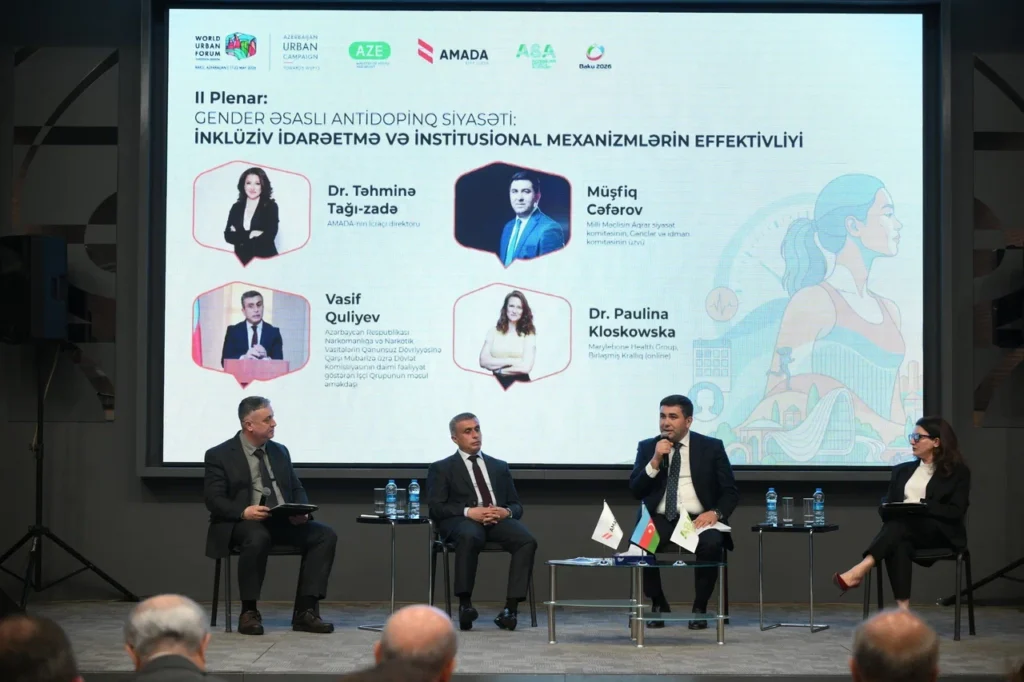
AMADA brings gender equality and inclusive clean sport into the Baku Urban Week agenda
The Azerbaijan National Anti-Doping Agency (AMADA) held an international partnership event titled “Inclusive Anti-Doping Approaches for Women and Girls in Sports Environments in Cities and Regions within the Framework of Gender Equality” on 15 May 2026 in Baku.
Organized at the Azerbaijan Sports Academy, the event took place within the framework of Baku Urban Week and the broader preparations for the 13th Session of the United Nations World Urban Forum (WUF13), to be hosted in Baku. The initiative was also linked to Azerbaijan’s “Year of Urban Planning and Architecture”, placing clean sport, gender equality, and athlete protection within the wider discussion on healthy, inclusive, and sustainable urban development.
The event brought together representatives of public institutions, sport organizations, academia, and international experts to discuss how gender-sensitive anti-doping approaches can contribute to safer and more inclusive sports environments for women, girls, and athletes with specific health and accessibility needs.
The opening ceremony featured remarks by Fuad Hajiyev, Rector of the Azerbaijan Sports Academy; Nigar Arpadarai, Member of the Milli Majlis of the Republic of Azerbaijan and Chairperson of AMADA’s Supervisory Board; Elnur Mammadov, Head of the Sports Department at the Ministry of Youth and Sports of Azerbaijan; and Dr. Tahmina Taghi-zada, CEO of AMADA.
In her reflection on the event, Nigar Arpadarai emphasized the importance of promoting gender equality, inclusivity, and clean sport principles as part of building a healthy and sustainable society. She also commended the AMADA team and the Azerbaijan Sports Academy for advancing this timely initiative.
The programme continued with two substantive plenary sessions. The first session, “Inclusive Environment for Female Athletes: Risk Factors, Health and Educational Approaches,” was moderated by Dr. Tahmina Taghi-zada, CEO of AMADA. The session featured contributions from Fuad Hajiyev, Elnur Mammadov, Nurlana Mammadzada, Secretary General of the Azerbaijan Gymnastics Federation, and Prof. Mike Callan of the University of Hertfordshire, United Kingdom.
The second session was moderated by Dr. Rufat Efendiyev, Deputy CEO of AMADA, Chair of the Council of Europe’s T-DO Ad Hoc Group of Experts on Gender Mainstreaming in Anti-Doping (T-DO GEMA), and CAHAMA Gender Equality Rapporteur.
Under the theme “Gender-Based Anti-Doping Policy: Inclusive Governance and the Effectiveness of Institutional Mechanisms,” the session examined how anti-doping policy can better respond to gender-specific realities, institutional coordination needs, and emerging public health challenges. Speakers included Dr. Tahmina Taghi-zada; Mushfiq Jafarov, Member of the Agrarian Policy Committee and the Youth and Sports Committee of the National Assembly of Azerbaijan; Dr. Vasif Guliyev, Responsible Officer of the Permanent Working Group of the State Commission on Combating Drug Addiction and Illicit Trafficking of Narcotic Drugs; and Dr. Paulina Kloskowska of Marylebone Health Group, United Kingdom, who joined online.
A central message of the event was that clean sport must be understood not only as a regulatory or testing issue, but also as part of a broader ecosystem of health, education, gender equality, and inclusive governance. AMADA’s concept for the event connected this approach to the UN Sustainable Development Goals, particularly SDG 3 – Good Health and Well-Being, SDG 5 – Gender Equality, SDG 10 – Reduced Inequalities, SDG 11 – Sustainable Cities and Communities, and SDG 16 – Peace, Justice and Strong Institutions.
The concept note also highlighted the importance of targeted prevention and education for groups that may face specific vulnerabilities, including adolescent girl athletes, female athletes, and Paralympians. These considerations include risks linked to supplement use, limited anti-doping awareness, therapeutic use exemption procedures, and the intersection of health-related needs with anti-doping regulations.
By presenting gender-sensitive anti-doping education within the context of urban sustainability, AMADA advanced a forward-looking vision of “clean city – clean sport”: an approach in which sports environments contribute to healthier communities, stronger institutions, and more inclusive societies. The initiative demonstrated how anti-doping organizations can play a meaningful role in wider international policy conversations on gender equality, public health, sustainable cities, and sport integrity.



Thank you for your rating!
Share your thoughts