Is sport integrity entering a new era of international cooperation?
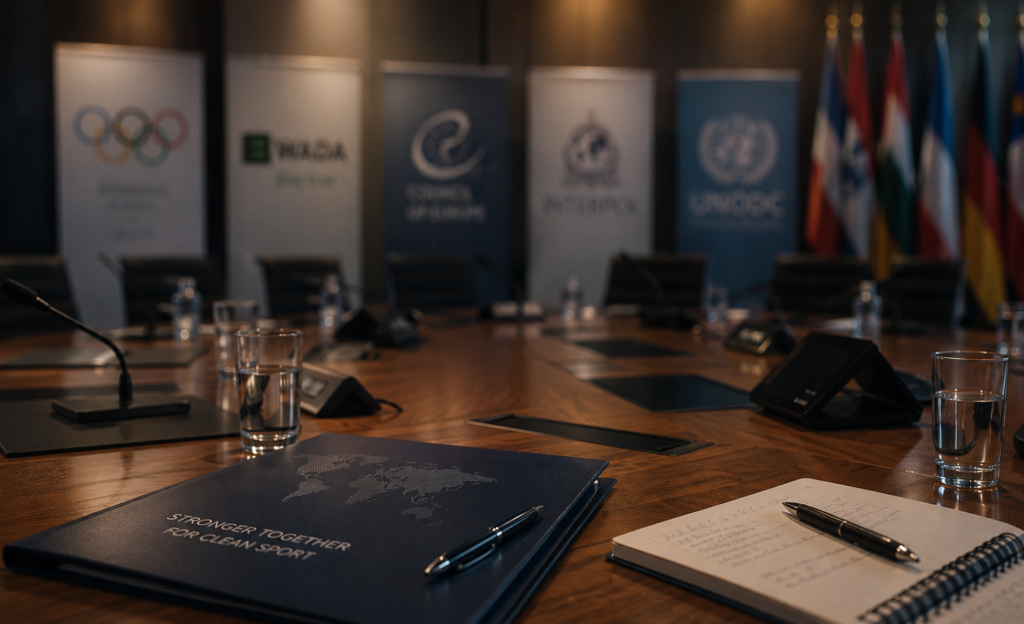
Recent initiatives involving the IOC, WADA, the Council of Europe, INTERPOL, UNODC and other partners suggest that international cooperation is becoming more than a supporting mechanism. It is increasingly becoming part of the operating infrastructure of modern sport integrity governance.
Analysis
Over several decades, international sport integrity has progressively invested in strengthening institutions. Recent developments suggest that this progress is increasingly being complemented by a further task: enabling strong institutions to work together with greater speed, trust and strategic coherence.
That is the deeper significance of the International Olympic Committee’s (IOC) latest account of cooperation with the Council of Europe, INTERPOL, the United Nations Office on Drugs and Crime and the World Anti-Doping Agency (WADA). Read narrowly, it is a record of workshops, expert discussions and regional initiatives. Read strategically, it points to a change in the way integrity is being organised internationally.
The emerging model is not based on one institution assuming responsibility for every threat. Nor should it be. Its strength lies in connecting organisations with different mandates: sport bodies, governments, law enforcement authorities, international organisations, betting stakeholders, anti-doping organisations and athletes themselves. The central question is therefore no longer only whether each institution possesses sufficient capacity. It is whether the system can convert complementary capacities into coordinated action.
This goes beyond the language of partnership. It concerns the practical coordination of complementary responsibilities.
From institutional capacity to system capability
For many years, progress in sport integrity was understandably measured through the development of individual institutions. National Anti-Doping Organisations (NADOs) strengthened testing, education, investigations and results management. International Federations (IFs) expanded integrity functions. Governments adopted and implemented international commitments. WADA developed and safeguarded a harmonised global anti-doping framework. The IOC broadened its work on competition manipulation and related integrity risks.
Those achievements remain indispensable. Yet the character of the risks facing sport has changed. Competition manipulation may involve organised criminal groups, illegal betting markets, financial transactions, digital communications and actors operating across several jurisdictions. Doping cases may require cooperation among sport organisations, customs authorities, police, laboratories, public prosecutors and health or regulatory bodies. Corruption, economic crime, athlete exploitation and emerging technological threats similarly resist institutional isolation.
When the risk crosses sectors, the response must cross sectors as well.
The initiatives described by the IOC make this development visible. The regional workshop in Harare under the IOC-INTERPOL Integrity in Sport Initiative did not bring together sport organisations alone. National Olympic Committees and law enforcement agencies from across Africa worked alongside contributions from UNODC, the Council of Europe, FIFA and CAF, with ANOCA also represented. The value of such a format lies not only in transferring knowledge on regulation, education and case management. It lies in creating working relationships before a crisis, an investigation or a request for cooperation makes those relationships urgent.
Trust is often described as an intangible asset. In integrity work, it is operational capacity.
International agreements establish authority and shared expectations. Procedures define how institutions should communicate. Yet when a time-sensitive case emerges, cooperation often depends on something less visible: whether the relevant people know whom to contact, understand one another’s constraints and trust that information will be handled responsibly. This is why regional workshops, expert round tables and recurring professional exchanges have strategic value beyond the agendas they formally address. They create the human and institutional confidence that allows legal mandates and technical systems to work under pressure. Trust does not replace accountability, safeguards or clear procedures; it enables them to operate across institutional boundaries.
A more connected integrity architecture
The UNODC Expert Round Table on tackling corruption in sport offers a second illustration. Its agenda linked illegal betting and competition manipulation with organised crime, financial crime, governance vulnerabilities, athlete transfers and the mutual expectations of governments and the sports movement. The discussion on sharing account-based information between betting operators and sports organisations was especially revealing. It moved the debate from general commitments towards the practical conditions under which information can become actionable.
This is where international cooperation either becomes real or remains rhetorical. Agreements create permission to cooperate. Operational channels, professional trust, lawful information-sharing arrangements and clarity of responsibility make cooperation function.
The planned IOC-UNODC-INTERPOL workshop in Uzbekistan extends this approach to Central Asia and the South Caucasus, bringing together stakeholders from Uzbekistan, Kazakhstan, Kyrgyzstan, Azerbaijan, Tajikistan and Turkmenistan. Its regional character matters. Integrity risks do not respect national borders, but neither can effective cooperation be designed only from the global level. Regional formats help translate international principles into relationships, procedures and expectations suited to neighbouring jurisdictions with shared risks and practical interdependencies.
A resilient international system therefore requires several layers at once: global standards, regional cooperation and national implementation. Weakness at any one of these levels can limit the effectiveness of the others.
The contribution of distinct mandates
The emerging architecture is notable because it does not depend on institutional uniformity. It depends on complementarity.
The IOC can convene actors across the Olympic Movement and connect integrity work to major sporting events. WADA provides the global regulatory and coordination framework for anti-doping and sustains structured engagement with governments, NADOs and RADOs. UNESCO’s International Convention against Doping in Sport gives governments a universal intergovernmental framework for supporting anti-doping. The Council of Europe contributes through the Anti-Doping Convention and, in the field of competition manipulation, through the Macolin Convention and its Follow-Up Committee.
Within the Macolin framework, the Group of Copenhagen provides an operational network of national platforms. The IOC Olympic Movement Unit on the Prevention of the Manipulation of Competitions presented its intelligence work related to the Milano Cortina 2026 Olympic Winter Games, while further dialogue with the Council of Europe is planned on sporting-related competition manipulation.
INTERPOL brings law enforcement cooperation and access to policing networks. UNODC contributes expertise on corruption, organised crime, economic crime and criminal justice. International Federations, continental bodies, National Olympic Committees, anti-doping organisations, public authorities, betting operators and athlete ambassadors each add knowledge that no single international institution can reproduce on its own.
The point is not to blur these mandates. It is to connect them without weakening accountability, legal safeguards or institutional independence. Effective cooperation should make responsibility clearer, not less visible.
Where global standards become trusted action
The contribution of the IOC unit to WADA’s regional symposia is particularly significant because it reflects a broader understanding of clean sport. A dedicated session during the WADA Regional Symposium Webinar Series for Europe and Africa brought together athlete ambassadors, law enforcement representatives and other stakeholders to consider competition manipulation. A further session at the WADA Symposium in Lima is expected to include INTERPOL, National Olympic Committees, athlete ambassadors and CONMEBOL.
These engagements do not merge anti-doping with every other integrity field. They recognise that the institutions responsible for different risks increasingly need to understand one another’s work. The practical value is mutual: anti-doping networks gain exposure to wider integrity and law enforcement perspectives, while other actors better understand the structures, regional relationships and government engagement mechanisms developed through the global anti-doping system.
For WADA, this highlights an important dimension of its global role. Its contribution extends beyond standard-setting and compliance monitoring to helping a diverse global community translate common principles into credible national and regional action. That task requires more than technical knowledge. It requires diplomatic judgement, sensitivity to different legal and institutional environments, the ability to build trust among governments and NADOs, and the capacity to turn international priorities into practical cooperation.
The future effectiveness of global integrity governance may increasingly depend on professionals who can move confidently between policy and operations, between governments and sport organisations, and between global expectations and regional realities.
From meetings to an operating model
International cooperation has, of course, existed for decades. What appears to be changing is its character. It is becoming more regular, multidisciplinary and operational.
Workshops are no longer simply educational events. They are opportunities to establish contacts that may later support case management, referrals or investigations. High-level discussions are no longer limited to declarations of principle. They increasingly address information flows, institutional expectations and achievable follow-up actions. Athlete ambassadors are not present merely to provide visibility; their lived experience helps institutions understand the human consequences of integrity failures. Regional symposia are not separate from global governance; they are where global commitments are interpreted, tested and implemented.
The test of progress will therefore not be the number of organisations listed in a partnership announcement. It will be whether cooperation produces clearer pathways for action: who shares what, with whom, under which authority, at what stage and for what purpose.
Connectivity should not become another abstract objective. It should be designed, maintained and evaluated as a strategic capability.
Looking ahead
It would be premature to claim that a fully connected international integrity ecosystem already exists. The organisations involved operate under different legal frameworks, governance arrangements and mandates. Information cannot always be exchanged freely, and cooperation must respect data protection, due process, jurisdictional limits and institutional independence.
These constraints are not arguments against cooperation. They are reasons to make cooperation more disciplined.
The initiatives highlighted by the IOC suggest that the international community is beginning to move in that direction. The most promising feature is not simply the expansion of partnerships, but the growing effort to connect policy, intelligence, law enforcement, education, athlete experience and regional implementation.
For many years, sport integrity has benefited from sustained investment in stronger organisations. An increasingly important dimension of its continued evolution is the strengthening of relationships between them.
The distinction is subtle, but its implications are substantial. Tomorrow’s integrity system will be judged not only by the quality of its rules or the capacity of its institutions, but by whether organisations with different responsibilities can learn together, prepare together and, when circumstances require it, act together.
International cooperation has long supported sport integrity. Recent initiatives demonstrate how this cooperation is becoming increasingly operational, continuous and embedded in practice.
This represents an important evolution in the way institutions coordinate their complementary responsibilities.
Source note
This analysis takes as its starting point the IOC Integrity Newsletter article, “Co-operation with intergovernmental organisations and WADA,” published on 9 July 2026.
https://www.olympics.com/ioc/news/co-operation-with-intergovernmental-organisations-and-wada
Further reading
IPSEI was established to support dialogue and knowledge exchange across the international sport integrity community, connecting international organisations, public authorities, sport bodies, researchers and practitioners around shared challenges.


Thank you for your rating!
Share your thoughts