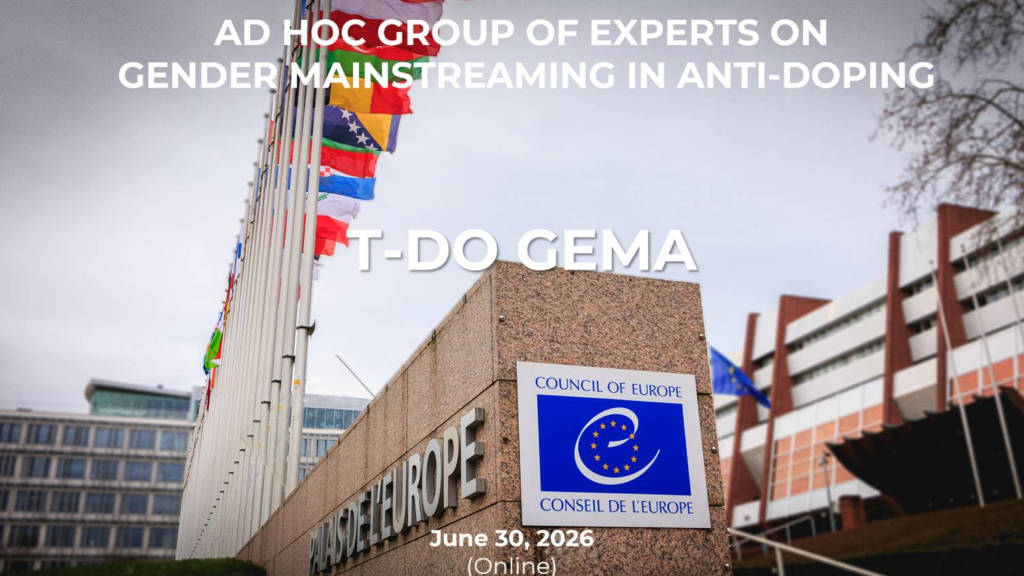
Towards gender-responsive anti-doping: T-DO GEMA reviews draft Recommendation
On 30 June 2026, the Council of Europe’s T-DO GEMA group held its next online meeting to continue work on the draft Recommendation on gender mainstreaming in anti-doping, including accompanying guidance for its implementation.
The meeting brought together experts to review the consolidated outcomes of five thematic work package discussions covering governance and policy, operational measures, education and prevention, access to justice and procedural safeguards, and research and evidence.
A key focus of the discussion was the need to ensure that gender equality is not treated as a separate or symbolic issue, but is integrated into the practical functioning of anti-doping systems. Experts discussed several cross-cutting questions, including terminology and scope, balanced representation, alignment with the World Anti-Doping Code and International Standards, proportionality, resource implications, and the appropriate level of detail for future guidance.
The group also discussed a newly proposed part of the accompanying guidance focusing on monitoring and reporting. Its central logic is to use existing monitoring mechanisms under the Council of Europe Anti-Doping Convention, rather than creating a separate reporting system. Participants considered how reporting could combine information on measures taken with relevant data, while remaining lawful, proportionate and sensitive to data protection requirements. Particular attention was given to safeguards for minors, Protected Persons, small-number cases and sensitive anti-doping proceedings.
The meeting confirmed the importance of developing a Recommendation and implementation guidance that are both principled and practical. The next drafting phase will focus on refining the text, aligning terminology across the different parts of the document, and distinguishing between what should remain in the Recommendation and what may be better developed later as practical tools, templates or reporting fields.
The T-DO GEMA process reflects a broader shift in sport integrity policy: gender equality in anti-doping is not only a matter of representation, but also of governance, athlete experience, procedural fairness, education, evidence and accountability.
As the work continues, the emerging Recommendation may become an important reference point for strengthening gender-responsive approaches across the anti-doping community.



Thank you for your rating!
Share your thoughts