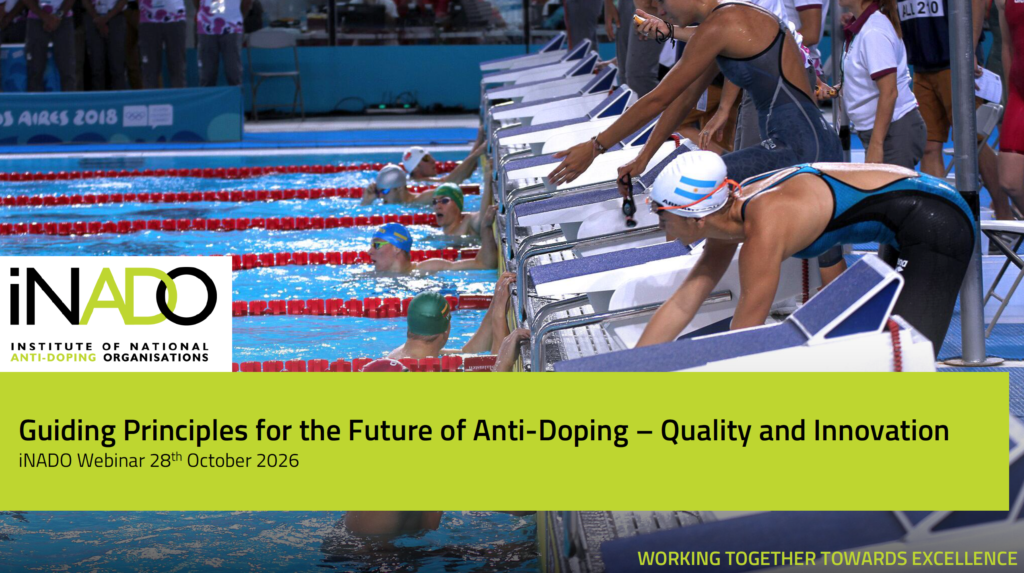
From athlete experience to responsible innovation: iNADO webinar explores quality and the future of anti-doping
An international webinar brought together perspectives from Timor-Leste, Azerbaijan, the United States, the United Kingdom, South Korea and Switzerland to explore athlete-centered services, clean performance education, scientific expertise, data analytics, capacity building and technological innovation.
Quality and innovation are increasingly central to the future of anti-doping. As organisations face growing operational responsibilities, rapid technological developments and rising expectations from athletes, the challenge is not simply to introduce new tools, but to ensure that they deliver meaningful improvements in the protection of clean sport.
These priorities were explored during the “Quality of Delivery and Innovation”webinar, organised by the Institute of National Anti-Doping Organisations (iNADO) on 28 October 2026 as part of its Guiding Principles for the Future of Anti-Doping series.
The webinar was moderated by Rufat Efendiyev, Deputy Chief Executive Officer of the Azerbaijan National Anti-Doping Agency (AMADA), and brought together speakers representing different dimensions of anti-doping practice, from athlete experience and education to scientific support, data-driven operations and quality management.
The discussions reflected a shared objective: strengthening the effectiveness, accessibility and reliability of anti-doping programmes through practical innovation and international cooperation.
Athlete experience: where quality begins
The webinar opened with Kerry Pither Cristalina Galhós, a former national tennis representative of Timor-Leste and an anti-doping professional, who presented an athlete-centred perspective on the quality of anti-doping services.
Drawing on her experience in sport and anti-doping administration, Galhós highlighted the importance of clear communication, respectful procedures, accessible education and consistent service delivery.
Her contribution illustrated how the effectiveness of anti-doping programmes depends not only on institutional processes but also on athletes’ understanding of their rights and responsibilities and their confidence in the systems designed to protect them.
Clean performance education and responsible AI
Dr Tahmina Taghi-zada, Chief Executive Officer of AMADA, presented “Innovation in Anti-Doping: Clean Performance Education and Responsible AI,” examining how anti-doping education can evolve to address athletes’ practical performance needs alongside their regulatory responsibilities.
A central element of her presentation was the CLEAN concept, which brings together five interconnected dimensions: characterising the athlete, managing training loads intelligently, ensuring appropriate energy support, promoting adaptation and recovery, and strengthening psychological preparation and anti-doping literacy.
The approach reflects a shift towards equipping athletes with evidence-informed knowledge and practical alternatives for achieving high performance without prohibited substances or methods.
Taghi-zada also discussed opportunities for integrating sports science and personalised education, including the potential use of artificial intelligence to develop adaptive, multilingual learning resources. She emphasised that technological innovation must remain subject to appropriate safeguards, including data protection, transparency, professional validation and human oversight.
Scientific expertise in everyday anti-doping operations
Dr Matthew Fedoruk, Chief Science Officer of the United States Anti-Doping Agency (USADA), examined how scientific knowledge supports the operational activities of national anti-doping organisations.
His presentation explored the application of scientific expertise across testing, the Athlete Biological Passport, results management and investigations, demonstrating how evidence-based approaches can contribute to more effective operational decisions.
The discussion highlighted the importance of integrating scientific developments into everyday anti-doping practice while maintaining consistency, analytical rigour and professional judgement.
Data analytics and smarter organisational processes
George Escott, Data Analytics Lead at UK Anti-Doping (UKAD), addressed the role of data and technology in improving the efficiency and effectiveness of anti-doping operations.
Drawing on UKAD’s experience, he examined how information distributed across different organisational systems can be better connected, analysed and transformed into actionable insights.
His contribution highlighted the value of identifying specific operational challenges before introducing new digital solutions, as well as the importance of reliable data, information security and measurable outcomes.
The presentation demonstrated how data analytics can support organisational decision-making and continuous improvement when technology is aligned with practical needs.
Capacity building through international cooperation
Rachel Jeongah Kwon, Director of International Relations at the Korea Anti-Doping Agency (KADA), focused on strengthening institutional capacity through international cooperation and professional development.
Her presentation highlighted the particular challenges facing smaller national anti-doping organisations, where limited staffing and resources may create difficulties in maintaining specialised expertise and delivering increasingly complex programmes.
Drawing on KADA’s capacity-building experience, Kwon discussed professional exchanges, practical training and cooperation initiatives aimed at supporting sustainable institutional development.
Her contribution underlined the importance of needs-driven partnerships that respect local contexts and promote institutional ownership. She emphasised that sustainable capacity building goes beyond training individuals, aiming to strengthen organisational capabilities and enable NADOs to develop and maintain effective anti-doping programmes independently over time.
Quality management and technological reliability
The final presentation was delivered by Vreni Müller and Dr Isabel Hofer of Berlinger Special AG, Switzerland, who explored quality management practices and technological developments relevant to anti-doping operations.
Their contribution addressed manufacturing quality, process reliability, traceability, continuous improvement and the importance of systematic controls throughout the product lifecycle.
The speakers also presented developments related to androgen detection technology, illustrating the continuing role of specialised industry expertise in supporting innovation within the anti-doping sector.
Their presentation reinforced the importance of reliable procedures, quality assurance and technological development in maintaining confidence in anti-doping processes.
Advancing quality through shared expertise
Across the six presentations, the webinar demonstrated the breadth of approaches contributing to the improvement of anti-doping programmes.
From the athlete experience to scientific support, education, analytics, institutional capacity and quality management, the discussions highlighted different but complementary dimensions of effective anti-doping delivery.
The exchange also underscored the importance of cooperation between national anti-doping organisations, athletes, scientific specialists and technology providers.
Through its Guiding Principles for the Future of Anti-Doping series, iNADO continues to facilitate international dialogue on practical approaches to strengthening anti-doping systems and supporting their future development.
For the wider sport integrity community, the webinar highlighted the value of sharing expertise across institutional and disciplinary boundaries, ensuring that emerging innovations are accompanied by professional competence, accountability and a continued commitment to athlete protection.
Quality and innovation remain essential to the future of anti-doping, with their ultimate value reflected in the effectiveness, fairness and trustworthiness of the systems they help build.

Thank you for your rating!
Share your thoughts