From commitments to accountability: Monaco puts child protection at the centre of sport integrity
The Council of Europe’s 19th Conference of Ministers Responsible for Sport has delivered a new resolution on safer and healthier sport for children. Beyond the political commitment, the Monaco gathering highlighted a wider transformation in sport integrity governance — one that places safeguarding, institutional independence, scientific evidence and measurable accountability at the heart of protecting young athletes.
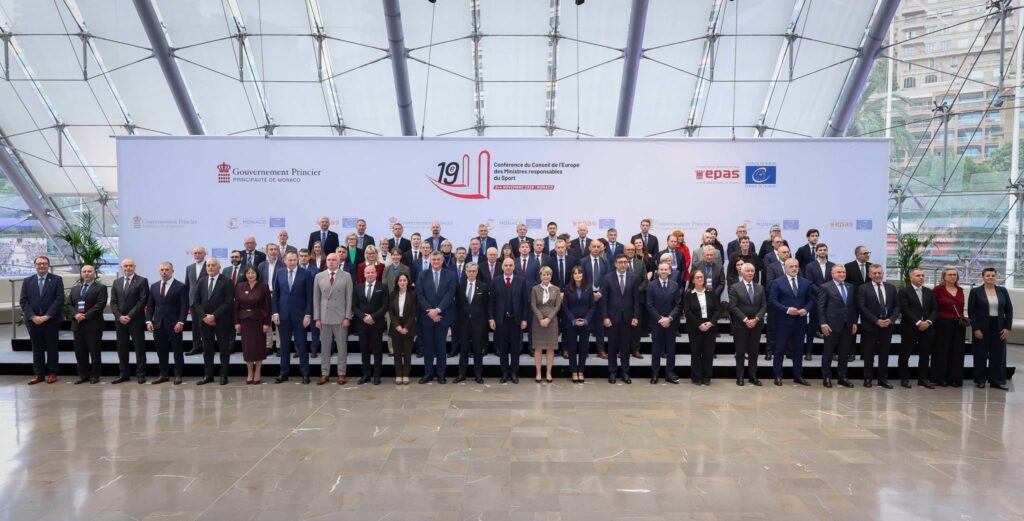
The 19th Council of Europe Conference of Ministers Responsible for Sport concluded at the Grimaldi Forum with the adoption of a resolution on safer and healthier sport for all children and young people.
Organised by the Council of Europe’s Enlarged Partial Agreement on Sport (EPAS) in cooperation with the Principality of Monaco, the conference brought together approximately 300 participants, including 25 ministers and state secretaries, representatives of international sporting organisations, researchers and safeguarding specialists.
Under the theme Safer and Healthier Sport for All Children, the discussions addressed two interconnected priorities: preventing and responding to violence and abuse, and protecting the physical and psychological well-being of young people involved in sport.
The significance of the gathering, however, extends beyond the adoption of another ministerial declaration. The central challenge is implementation: who is responsible for protecting children in sport, what mechanisms should exist when protection fails, and how can institutions demonstrate that their commitments produce meaningful results?
The adopted resolution, together with contributions from international organisations and independent experts, points towards a more integrated approach to sport integrity — connecting prevention, institutional accountability, evidence-based policymaking and practical safeguarding measures.
Sport integrity begins with children’s rights
Opening the conference alongside Prince Albert II of Monaco, Council of Europe Secretary General Alain Berset delivered a broader message about the relationship between sport, human rights and responsible governance.
“Human rights, democracy and the rule of law do not stop at the side of the playing field.”
The statement, reproduced in the Council of Europe’s official English-language account of the opening, reflects a principle that extends across the international sporting system: organisational autonomy and responsibility must operate together.
In his opening address, Berset connected the protection of children with the wider governance architecture developed by the Council of Europe, including its work on anti-doping, competition manipulation and safety at sporting events.
This connection is important. Safeguarding is increasingly being understood not as an isolated welfare function, but as an integral component of responsible sports governance.
A sporting organisation may possess extensive technical regulations, disciplinary procedures and performance-development programmes. Yet those arrangements alone cannot guarantee a safe environment if children lack accessible reporting mechanisms, if complaints are not handled appropriately or if institutional interests interfere with the protection of individuals.
The Monaco discussions reinforced the understanding that safeguarding requires clear responsibilities, credible institutional arrangements and cooperation between public authorities, sporting organisations and civil society.
This approach also builds upon the Parliamentary Assembly of the Council of Europe’s Resolution 2607 (2025), Protecting human rights in and through sport: obligations and shared responsibilities, which addressed the importance of integrating human-rights responsibilities into sports governance.
The message was reinforced during the Monaco conference by Mogens Jensen, Chair of the Parliamentary Assembly’s Committee on Culture, Science, Education and Media.
Speaking on 4 November, Jensen called for clear safeguarding responsibilities, trusted reporting mechanisms, meaningful protection for victims and responsible institutional leadership.
Together, these developments illustrate a growing emphasis on translating sporting values into practical governance responsibilities.
The evidence behind the urgency
The need for effective safeguarding mechanisms is supported by an expanding body of international research.
A peer-reviewed study published in Child Abuse & Neglect in 2023 by Mike Hartill and colleagues examined experiences of interpersonal violence in organised sport among 10,302 adults aged 18–30 who had participated in sport during childhood.
The research covered Austria, Belgium, Germany, Romania, Spain and the United Kingdom.
Among respondents, 65% reported psychological violence, 44% physical violence, 37% neglect, 35% non-contact sexual violence and 20% contact sexual violence during their childhood sporting experiences.
These findings reflect retrospective self-reported experiences within a defined six-country research sample. They should not be interpreted as representative prevalence estimates for every country, sporting discipline or organisation.
Nevertheless, the findings provide substantial evidence that safeguarding risks extend across multiple forms of interpersonal violence and require systematic attention.
The research, Prevalence of interpersonal violence against children in sport in six European countries, also reinforces the importance of examining organisational cultures, power relationships and the broader environments in which children participate in sport.
The evidence-based perspective was further reflected in the contribution of the International Council of Sport Science and Physical Education (ICSSPE), published on 3 November 2026 in connection with preparations for the conference and the meeting of the EPAS Consultative Committee.
ICSSPE emphasised that safeguarding policies and frameworks cannot be assessed solely by their existence. Their effectiveness depends on implementation, adequate support for those responsible and the systematic use of scientific evidence to inform decision-making.
The distinction is fundamental: adopting a safeguarding policy represents an institutional commitment; demonstrating its effectiveness requires evidence.
For sport integrity governance, this reinforces the importance of connecting policy design with implementation, evaluation and continuous improvement.
A new health challenge: more participation, less harm
The conference also took place against an increasingly important global public-health backdrop.
On 4 November 2026, the World Health Organization released new global estimates of adolescent physical activity, drawing on 389 population-based surveys involving more than 3.2 million adolescents across 140 countries and territories.
The findings showed that approximately one in four adolescents aged 11–17 reported no day in the previous week with at least 60 minutes of moderate-to-vigorous physical activity.
Only 14% reported achieving that level of activity on all seven days.
The gender gap remained pronounced: 28% of girls reported no active days, compared with 22% of boys.
These findings highlight an important policy challenge. Governments need to expand opportunities for physical activity, yet participation must take place in environments that protect young people’s health, dignity and well-being.
Accessibility and safeguarding should therefore be understood as complementary objectives.
The Council of Europe’s conference conclusions reflected this broader understanding of children’s welfare, addressing mental health, concussion and injury prevention, overtraining, excessive performance pressure and the risks associated with doping and substance misuse.
The pursuit of sporting excellence, particularly at an early age, creates additional responsibilities for coaches, parents, medical professionals and sporting authorities.
Achievement should not come at the expense of children’s health or their right to enjoy sport.
From safeguarding policies to institutional accountability
One of the most consequential outcomes of the Monaco conference was the adoption of Resolution MSL19(2026)5rev8, Safer and healthier sport for all children and young people.
The resolution invites member states to integrate children’s rights into national sports policies through cooperation involving public authorities, the sporting movement and civil society.
It also calls for sporting organisations, from grassroots to professional level, to adopt, implement and regularly review evidence-informed, trauma-informed and child-centred safeguarding policies and procedures.
Among the measures addressed are clearly assigned safeguarding responsibilities, appropriately trained safeguarding officers, safer recruitment frameworks, child-friendly reporting channels and effective referral to specialist support services.
The resolution also emphasises independent reporting and investigation, protection for victims and whistleblowers, and effective accountability.
These provisions demonstrate an important shift in emphasis.
Safeguarding cannot be evaluated solely by counting the policies an organisation has adopted, the educational activities it has organised or the formal commitments it has made.
An effective system also requires credible information about implementation, responsiveness, organisational accountability and the experiences of those it is intended to protect.
Among the measures encouraged by the adopted resolution is greater transparency through safeguarding reporting. The document invites sporting organisations, where resources permit, to publish annual information, including anonymised and aggregated data, in accordance with applicable data-protection regulations.
This is an invitation directed towards the sporting movement, not an automatic legal requirement imposed on individual federations by the resolution itself.
When appropriately designed, such approaches can support evidence-based evaluation and continuous improvement while respecting privacy, confidentiality and relevant institutional responsibilities.
The wider objective is to strengthen the capacity of sporting organisations to demonstrate that safeguarding arrangements are effective in practice.
Independent mechanisms and the protection of those who speak up
The question of institutional independence emerged as a particularly important dimension of the Monaco discussions.
On 5 November, Play the Game published the intervention delivered at the conference by its head, Stanis Elsborg.
Elsborg called for stronger safeguards for children and others reporting wrongdoing in sport, highlighting the importance of independent investigations, secure reporting mechanisms and protection against retaliation.
He encouraged governments to establish or strengthen independent national safeguarding and whistleblower mechanisms with appropriate expertise, resources and clearly defined responsibilities.
An important element of the intervention concerned the proposed ClearingSport initiative.
Developed by Play the Game with input from more than 200 experts, according to the organisation, ClearingSport has been proposed as an independent international mechanism to address abuse and other sport integrity breaches through stronger investigative arrangements and whistleblower protection.
The proposal was advanced by Play the Game and should not be confused with a decision or institutional commitment adopted by the ministers at Monaco.
Nevertheless, its presentation illustrates a wider international discussion about how independence, cross-border cooperation and institutional accountability can strengthen existing sport integrity systems.
The relevance extends beyond safeguarding alone.
Questions concerning institutional independence, conflicts of interest, access to reliable information and the protection of individuals who report wrongdoing are shared by several dimensions of sport integrity.
The central challenge is how to establish credible mechanisms that complement existing authorities, respect legal responsibilities and provide appropriate protection without duplicating or undermining established institutional mandates.
Young people as participants in policymaking
Another noteworthy element of the conference process was the involvement of young people in preparing the ministerial discussions.
On 26–27 May 2026, the Council of Europe organised the event Youth Perspective for Safe and Healthy Sport at the European Youth Centre in Strasbourg.
The gathering brought together 49 young participants aged 19–29 from 32 EPAS member states.
Organised alongside the annual joint plenary meeting of the EPAS Governing Board and Consultative Committee, the event provided an opportunity for participants to share their experiences and recommendations concerning safer, healthier and more inclusive sport.
Their contributions were intended to inform preparations for the Monaco conference, including the development of the ministerial resolution.
This approach reflects the growing recognition that effective sporting policies require meaningful engagement with the people whose experiences they are intended to improve.
The adopted resolution similarly encourages safe, voluntary, accessible and age-appropriate participation by children and young people in relevant decision-making.
Participation must, however, go beyond consultation as a procedural exercise.
For safeguarding policies to be effective, institutions need mechanisms through which young people’s experiences and feedback can contribute to evaluation, institutional learning and the continuous improvement of protective measures.
Inclusion is part of protection
The International Paralympic Committee brought a particularly important perspective to the conference.
Leila Marques, IPC First Vice-President and four-time Paralympian, emphasised that children with disabilities must have meaningful opportunities to participate in sport and benefit from safe, inclusive sporting environments.
In her address reported by the International Paralympic Committee, Marques identified inaccessible facilities, unsuitable equipment, inadequate transport and social exclusion among the barriers that continue to restrict participation.
Such barriers can prevent children from experiencing the benefits of sport before questions of sporting performance even arise.
Safeguarding arrangements must therefore consider not only protection from direct harm but also whether the systems intended to provide support are accessible and appropriate for children with different needs.
The implication is that inclusion must be integrated into sporting policy, organisational responsibility and the design of reporting and support mechanisms.
The Monaco conference also addressed wider barriers to participation, including poverty and geographical isolation.
A genuinely safe sporting environment is one that protects children from harm while enabling participation on equitable terms.
Clean sport and child safeguarding are interconnected
The Monaco resolution explicitly recognises the links between safeguarding and other areas of concern, including doping, substance misuse, technology-facilitated abuse and harmful practices affecting children’s physical and psychological well-being.
This connection is particularly relevant to the broader architecture of sport integrity.
For children and adolescents, safeguarding risks may emerge in environments where performance expectations are excessive, where young athletes depend heavily on adults for decisions concerning training or medication, or where health and educational support are inadequate.
These circumstances illustrate the importance of cooperation between sporting organisations, medical professionals, safeguarding specialists and anti-doping authorities within their respective mandates.
Anti-doping education and comprehensive child-safeguarding systems are mutually reinforcing pillars of sport integrity.
Their complementary roles contribute to protecting young athletes from harmful performance pressures, promoting informed decision-making and fostering sporting environments in which health, dignity and fair competition remain central priorities.
The adopted ministerial resolution encourages the exchange of knowledge and good practices across safeguarding, anti-doping and substance abuse, mental health, injury prevention, overtraining and related concerns.
It also envisages cooperation with relevant Council of Europe bodies addressing the abuse of doping substances, illicit drugs, falsified medicinal products and other interconnected risks.
The conference provided opportunities for dialogue beyond its main ministerial sessions.
According to coverage of Azerbaijan’s participation, Minister of Youth and Sports Farid Gayibov addressed the conference and met with World Anti-Doping Agency Director General Olivier Niggli to discuss international anti-doping cooperation.
Such exchanges illustrate the wider institutional setting in which international discussions on sport integrity continue to develop.
The central lesson is that protecting young athletes benefits from coordinated but clearly differentiated institutional responsibilities.
Safeguarding, anti-doping education and athlete welfare can reinforce one another while retaining their distinct purposes and professional requirements.
Moving from standards to practical safeguarding tools
The Monaco resolution builds upon work that the Council of Europe and international sporting organisations have undertaken over several years.
The Council of Europe’s Start to Talk initiative has supported national authorities and sporting organisations in developing safeguarding arrangements, providing specialist assistance and strengthening professional training and awareness.
One example is the implementation of Start to Talk in Cyprus, where cooperation supported safeguarding policies and procedures across four pilot sporting federations: football, gymnastics, swimming and triathlon.
The initiative also included the development of an evaluation tool to help assess continuing implementation.
More recently, ahead of the Monaco conference, EPAS published a new Toolkit on Prevention and Reaction to Child Sexual Abuse in Sport on 30 October 2026.
Developed through the Council of Europe’s Pool of International Experts on Safe Sport, the toolkit comprises six practical factsheets addressing definitions, legal frameworks, the recognition of abuse, appropriate responses, prevention and education.
Designed for adaptation to national contexts, it provides public authorities, sporting organisations and safeguarding professionals with practical resources for translating policy commitments into institutional procedures.
Another relevant development is the Council of Europe’s Guidelines on safer recruitment in sport: Human rights-compliant screening of professionals and volunteers in contact with children, adopted by the EPAS Governing Board on 4 July 2025.
The guidelines address recruitment and screening procedures, including relevant background checks, employment references, consideration of information from other jurisdictions and the protection of personal data.
They also acknowledge the potential of appropriately secured digital systems to make certain screening procedures more efficient.
These initiatives demonstrate that safeguarding requires more than broad institutional principles.
It depends on practical instruments, professional expertise, appropriate information management and the capacity to implement standards consistently across different levels of sport.
A growing international safeguarding architecture
The development of safeguarding standards also extends beyond the Council of Europe.
The International Olympic Committee has established safeguarding guidelines, educational programmes and athlete mental-health initiatives designed to strengthen protection across the Olympic Movement.
These include safeguarding resources for International Federations and National Olympic Committees, as well as programmes addressing harassment, abuse and mental well-being.
In March 2026, FIFA published its first comprehensive safeguarding policy, establishing a unified framework intended to strengthen prevention, reporting, institutional responsibilities and accountability across football.
These initiatives indicate growing international attention to safeguarding as an essential component of responsible sports governance.
However, they also raise a question that extends beyond individual organisations.
How can different safeguarding policies, education programmes, reporting arrangements and institutional responsibilities contribute to consistently effective protection across sporting disciplines, national jurisdictions and organisational levels?
The challenge is not simply to develop additional standards.
It is to strengthen implementation, support institutional learning, improve cooperation and identify shortcomings through reliable evidence.
This is where the connections between safeguarding and the wider sport integrity agenda become especially important.
Artificial intelligence as an enabler of safer and more accountable sport
The integration of artificial intelligence and advanced data analytics offers new opportunities to strengthen safeguarding, transparency and institutional accountability across sport.
The Monaco resolution explicitly invites EPAS and relevant partners to promote research and international dialogue concerning both the opportunities and risks associated with artificial intelligence in child safeguarding.
This recognition is significant because effective safeguarding increasingly depends on the quality, consistency and appropriate use of information across complex institutional environments.
AI-assisted systems could help identify patterns, inconsistencies and emerging risks that may otherwise remain unnoticed within fragmented information systems.
Through the structured analysis of lawfully obtained, appropriately governed and, where feasible, aggregated or anonymised information, advanced analytical technologies may support more consistent monitoring, earlier recognition of concerning patterns and better-informed institutional responses.
AI-assisted decision-support tools may also help improve procedural consistency and identify matters requiring independent professional attention.
These capabilities are particularly relevant where safeguarding responsibilities involve multiple organisations operating under different institutional and legal frameworks.
More broadly, reliable digital infrastructure can facilitate the organisation of information, reduce unnecessary fragmentation and support cooperation within clearly defined mandates and data-sharing arrangements.
However, technological effectiveness depends on the quality of the underlying information, transparent methodologies, appropriate safeguards and clearly assigned human responsibility.
AI-assisted analysis should therefore be understood as a means of supporting professional judgement and institutional accountability, rather than replacing either.
Responsible artificial intelligence can become an important component of the next generation of sport integrity infrastructure, connecting technological innovation with prevention, evidence-informed decision-making and public trust.
The opportunities are considerable, but their responsible application will depend on collaboration among technology specialists, safeguarding professionals, sporting authorities, researchers and other relevant stakeholders.
The next test: implementation and measurable progress
The adopted resolution provides a clearer basis for future international cooperation.
It invites EPAS, including its Governing Board, Consultative Committee, Pool of International Experts on Safe Sport and the Network of Magistrates and Prosecutors Responsible for Sport (MARS Network), to support the development and implementation of safeguarding measures.
The document also proposes considering the involvement of MARS Network in facilitating cooperation and exchanges with national prosecution authorities.
This illustrates the potential contribution of expertise extending beyond internal sporting governance mechanisms, particularly in areas where safeguarding responsibilities intersect with legal processes.
Another significant provision concerns future standard-setting.
The resolution invites EPAS to develop a Committee of Ministers’ recommendation to guide national strategies for preventing abuse and protecting children and young people in sport.
It also calls for a report to the Committee of Ministers in 2027 assessing progress in implementing the measures set out in the resolution.
The significance of this provision lies in the connection between political commitments and subsequent evaluation.
It establishes an identified follow-up process through which implementation progress is intended to be examined.
The broader policy challenge remains substantial.
Governments and sporting organisations need to determine how safeguarding commitments can be translated into effective arrangements at different levels of sport, from elite training environments to grassroots clubs and community programmes.
This requires cooperation among sport, education, health, child-protection and justice authorities, supported by professional expertise, appropriate resources and credible evidence.
It also requires a continuing commitment to hearing the experiences of children and young people.
Effective protection ultimately depends on institutions capable of listening, responding, learning and improving.
IPSEI perspective: toward an integrated approach to sport integrity
The Monaco conference illustrates a broader evolution in the international understanding of sport integrity.
The international sport integrity framework continues to evolve by bringing together the prevention of doping, competition manipulation, safeguarding, athlete welfare and other essential dimensions of responsible sports governance.
Clean Sport, Fair Sport and Safe Sport represent interconnected dimensions of a wider governance responsibility.
Each requires appropriate standards, credible institutions, effective implementation, proportionate safeguards and mechanisms for learning from evidence.
The developments discussed in Monaco also reinforce the importance of examining how different institutional arrangements interact.
Safeguarding policies depend on the capacity of organisations to prevent harm and respond appropriately when concerns arise.
Independent mechanisms contribute to institutional credibility.
Scientific research helps identify risks and assess the effectiveness of protective measures.
Digital technologies can support information management, analytical consistency and evidence-informed decisions.
International cooperation can facilitate shared learning and strengthen the ability of institutions to address challenges extending beyond individual organisations or jurisdictions.
From an integrated sport integrity perspective, these elements should be viewed as complementary rather than competing priorities.
Several questions deserve sustained international attention.
How consistently are safeguarding standards implemented across national sports systems? Are reporting and case-management arrangements sufficiently independent? Can children and families access them with confidence? What evidence is available to evaluate the effectiveness of protective measures? And how can information systems and emerging technologies strengthen international cooperation while respecting legal responsibilities and data protection?
These are not merely administrative questions. They concern institutional trust.
The future development of sport integrity governance will increasingly depend on the ability to connect standards with implementation, evidence with decision-making, and technological innovation with accountable institutional practice.
The Monaco resolution represents an important political commitment to placing children at the centre of sports governance. Its associated initiatives — from practical safeguarding toolkits and safer recruitment guidelines to independent accountability discussions and the planned assessment of progress in 2027 — demonstrate the breadth of the work involved in turning that commitment into practice.
The broader lesson for international sport integrity is clear: institutional credibility depends not only on the principles organisations endorse, but also on their capacity to implement those principles consistently, transparently and effectively.
The ultimate measure of progress will not be how many organisations declare their commitment to safe sport, but whether every child can participate with confidence, dignity and protection.


Thank you for your rating!
Share your thoughts