Performance-enhancing drugs: Is public attention accelerating?
IPSEI Pulse | Issue #3
Date of release: July 3, 2026
Tracking window: June 29, 2025 – June 28, 2026
The third issue of IPSEI Pulse examines whether public attention to performance-enhancing drugs has increased over the past year.
The expression “performance-enhancing drugs” is often used more broadly than the regulatory category of substances and methods included on the WADA Prohibited List. It may include prohibited substances, as well as non-prohibited medicines, supplements and other products discussed in public, medical and commercial contexts.
This issue follows IPSEI’s recent reflection on World Drug Day and the broader substance-risk environment around sport. Substance-related risks do not stop at the borders of sport. They are shaped not only by individual choices, but also by online markets, commercial narratives, informal supply chains, digital promotion and other factors.
The purpose of this analysis is not to measure use, prevalence, purchasing behaviour, approval, availability or health outcomes. Instead, it looks at attention behaviour: whether users searched more frequently for performance-enhancing drugs, whether they sought structured background information, and whether search interest and reference-based information seeking followed similar or different patterns.
Methodological note
This issue applies IPSEI’s Dual-Signal Attention Matrix, a comparative approach designed to observe how public visibility develops across two distinct layers of digital attention: discovery-oriented interest and reference-based information seeking.
Google Trends data are used to observe relative worldwide search interest for the term “performance-enhancing drugs“. Wikimedia pageviews are used to observe traffic to the relevant English-language Wikipedia reference page, “performance-enhancing substance“.
The matrix does not measure public opinion, approval, criticism, behavioural intent, substance use or prevalence. It focuses on attention dynamics: signal timing, peak concentration, reference traffic and the relationship between search behaviour and background information seeking.
Because Google Trends data are normalized, the analysis should be read as a topic-level attention signal rather than a direct measurement of absolute public demand.
Key findings
1. Search interest increased compared with the previous year
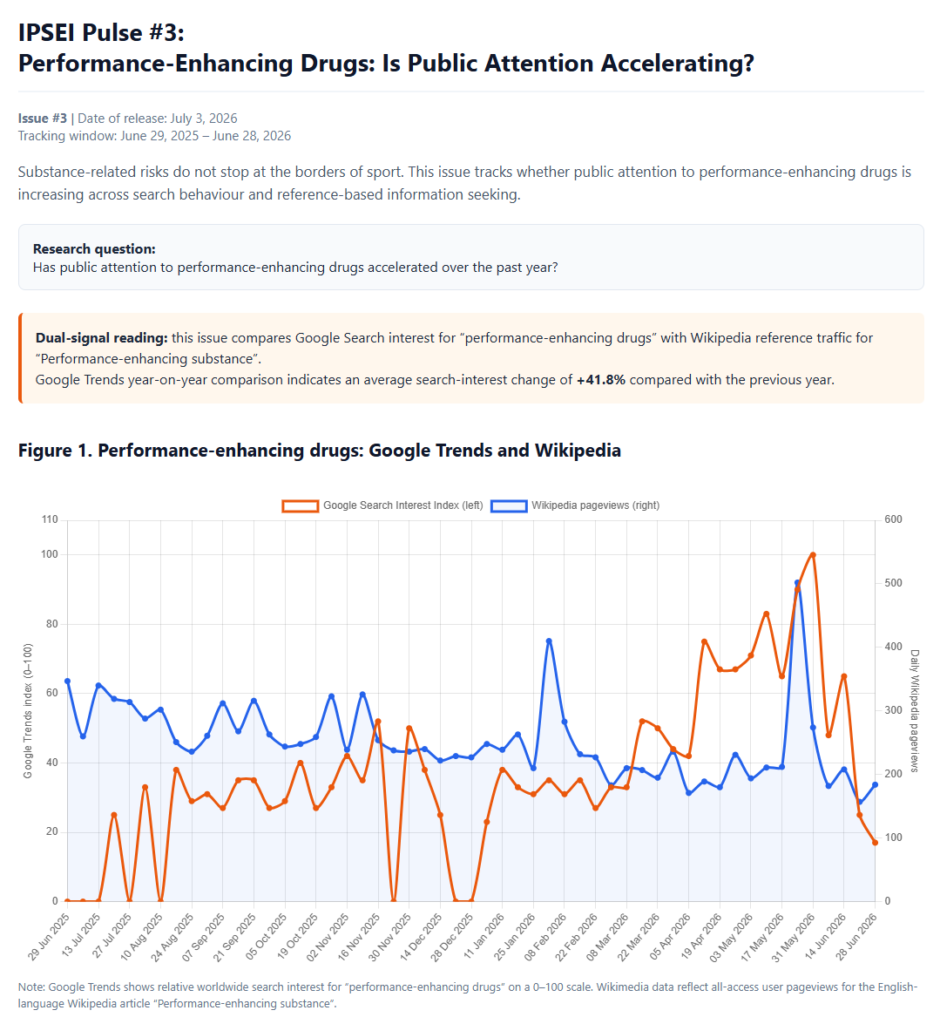
Google Trends year-on-year comparison indicates that average worldwide search interest for “performance-enhancing drugs” increased by 41.8% compared with the previous year.
While a single year of data does not establish a long-term trend, the observed increase indicates a notable acceleration in digital attention during the present tracking window.
This suggests that public curiosity around performance-enhancing drugs is not static. Rather, the term appears to be part of a broader digital attention environment shaped by enhancement culture, body optimization, recovery, strength, appearance, endurance and lifestyle transformation.
2. Search attention peaked at the end of May 2026
During the tracking window, Google Search interest for performance-enhancing drugs peaked at 100 on May 31, 2026.
The average Google Trends index during the matched window was 36.4. By the last matched day, June 28, 2026, Google Search interest stood at 17.
This pattern suggests that public attention was not evenly distributed across the year. Instead, it included a concentrated period of heightened search interest, followed by a decline from the observed peak.
3. Wikipedia reference traffic showed a separate attention pattern
Wikipedia pageviews for the English-language article “Performance-enhancing substance” peaked at 502 on May 24, 2026.
Across the matched tracking window, the article recorded 13,400 all-access user pageviews. The average number of daily Wikipedia pageviews was 252.8. On the last matched day, June 28, 2026, Wikipedia recorded 184 pageviews.
This indicates that performance-enhancing substances generated a steady level of reference-based information seeking, even though the Wikipedia signal did not mirror the Google Trends pattern closely.
4. Search interest and reference traffic did not move together
The simple daily correlation between Google Trends and Wikipedia pageviews was -0.10.
This weak negative correlation suggests that search attention and reference-based information seeking did not move together during the tracking window. In practical terms, people may search for performance-enhancing drugs without necessarily turning to encyclopaedic information sources.
This distinction matters. Search behaviour can reflect curiosity, news exposure, commercial promotion or social media visibility, while Wikipedia traffic is more likely to reflect background information seeking. The two indicators therefore capture different layers of public attention.
Strategic takeaway
The observed 41.8% year-on-year increase in Google Search interest suggests that public attention to performance-enhancing drugs accelerated during the present tracking window. Although a single year of data does not establish a long-term trend, the observed increase indicates a notable shift in digital attention over the period examined.
At the same time, the weak relationship between Google Search behaviour and Wikipedia traffic indicates that rising attention does not necessarily translate into deeper reference-based information seeking. Public interest may therefore be driven more by news coverage, commercial promotion, social media and online marketing than by educational or reference-based engagement.
For sport integrity stakeholders, this matters because substance-related risks are shaped not only by individual decisions, but also by online availability, informal supply chains, digital promotion and the normalization of enhancement-related products beyond elite sport.
Performance-enhancing drugs are no longer discussed only in the context of doping violations, testing and sanctions. They increasingly overlap with recreational fitness culture, body image pressures, recovery narratives, wellness markets, commercial health products and broader public health concerns.
Understanding not only what people use, but also what people search for and seek to learn about, can provide an additional evidence base for education, prevention and sport integrity policies. Although digital attention does not measure substance use or prevalence, it may serve as an early indicator of emerging public interest relevant to prevention, education and integrity policy development.
IPSEI Pulse is an analytical note by the International Platform for Sport Ethics & Integrity, tracking emerging signals across sport integrity, ethics, governance and public attention.
This analysis reflects IPSEI’s independent analytical perspective and is based on open digital attention indicators. It should not be interpreted as an institutional, regulatory, medical or legal assessment.



Thank you for your rating!
Share your thoughts