SARMs and anabolic steroids: what search and Wikipedia traffic reveal
IPSEI Pulse | Issue #2
Date of release: June 15, 2026
Tracking window: May 17, 2026 – June 14, 2026
The second issue of IPSEI Pulse examines how public attention around SARMs (Selective Androgen Receptor Modulators) and anabolic steroids developed across a short digital tracking window.
The purpose of this analysis is not to measure use, prevalence, purchasing behaviour, approval or health outcomes. Instead, it looks at attention behaviour: when users searched for these terms, when they appeared to seek more structured background information, and whether search interest and reference-based information seeking followed similar or different patterns.
Methodological note
This issue applies IPSEI’s Dual-Signal Attention Matrix, a comparative approach designed to observe how public visibility develops across two distinct layers of digital attention: discovery-oriented interest and reference-based information seeking.
For each topic, Google Trends data are used to observe relative search interest, while Wikimedia pageviews are used to observe traffic to the relevant English-language Wikipedia reference page.
For SARMs, Wikipedia traffic refers to the article “Selective androgen receptor modulator”. For anabolic steroids, Wikipedia traffic refers to the article “Anabolic steroid”.
The matrix does not measure public opinion, approval, criticism, behavioural intent, substance use or prevalence. It focuses on attention dynamics: signal timing, peak concentration, reference traffic and the relationship between search behaviour and background information seeking.
Because Google Trends data are normalized, the analysis should be read as a topic-level attention signal rather than a direct measurement of absolute public demand.
Key findings
1. SARMs showed a concentrated search signal, but reference traffic peaked later
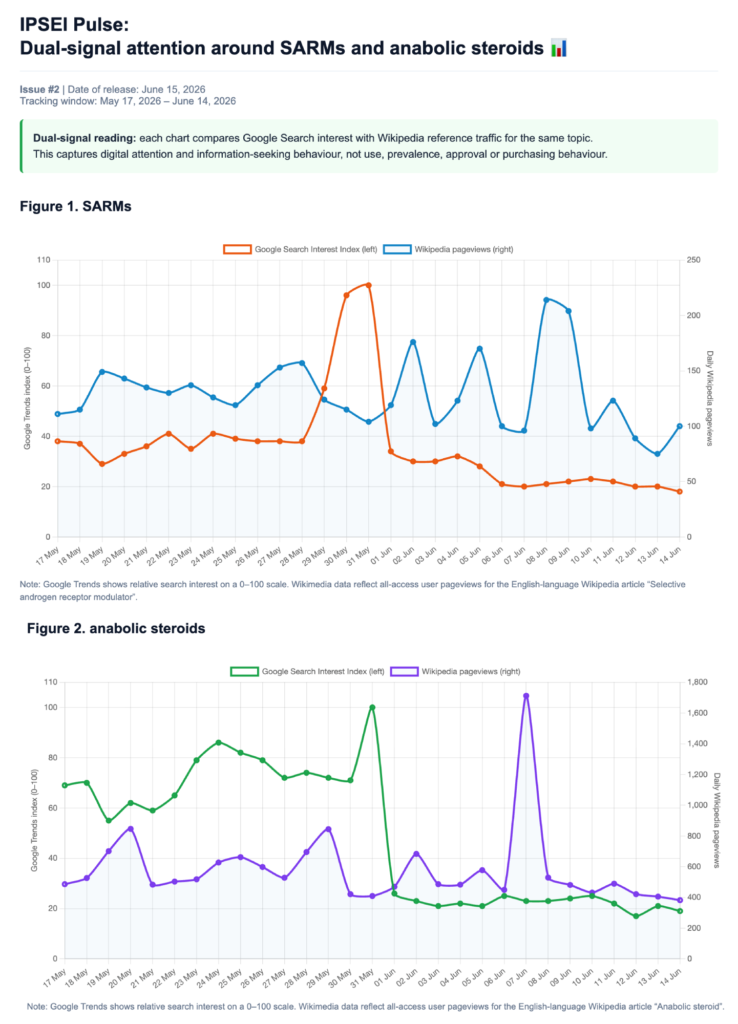
During the tracking window, Google Search interest for SARMs peaked at 100 on May 31, 2026. Wikipedia reference traffic for the relevant article peaked later, reaching 214 pageviews on June 8, 2026.
Across the matched tracking window, the relevant English-language Wikipedia article recorded 3,744 all-access user pageviews. By the last matched day, June 14, 2026, Google Search interest stood at 18, while Wikipedia recorded 100 pageviews.
This suggests that search attention and reference-based information seeking did not move in a closely synchronized way. The simple daily correlation between both indicators was -0.11.
2. Anabolic steroids showed a larger reference-traffic base
For anabolic steroids, Google Search interest also peaked at 100 on May 31, 2026. Wikipedia reference traffic peaked on June 7, 2026, reaching 1,712 pageviews.
During the matched tracking window, the English-language Wikipedia article on anabolic steroids recorded 16,844 all-access user pageviews. On June 14, 2026, Google Search interest stood at 19, while Wikipedia recorded 382 pageviews.
The simple daily correlation between both indicators was 0.01, suggesting that search interest and reference traffic remained largely independent during this short tracking period.
3. Both topics showed post-peak decline, but not synchronized co-movement
Both SARMs and anabolic steroids showed a decline from their highest observed values by the end of the tracking window. For SARMs, Google Search interest fell from 100 on May 31 to 18 on June 14, while Wikipedia pageviews declined from their June 8 peak of 214 to 100 on June 14.
For anabolic steroids, Google Search interest declined from 100 on May 31 to 19 on June 14, while Wikipedia pageviews fell from their June 7 peak of 1,712 to 382 on June 14.
However, the weak correlation between Google Search interest and Wikipedia pageviews suggests that this decline should not be interpreted as tightly synchronized co-movement. Rather, the two indicators appear to capture different layers of attention: immediate search curiosity on one side, and reference-based information seeking on the other.
Strategic takeaway
The two charts suggest that public attention around enhancement substances can be observed across both search behaviour and reference-based information seeking. However, unlike the attention pattern observed in the first IPSEI Pulse on The Enhanced Games, the two signals did not strongly move together in this tracking window.
This difference is meaningful. The Enhanced Games appeared as a concentrated event-driven attention spike. SARMs and anabolic steroids, by contrast, point to a broader substance-related information environment in which curiosity, reference seeking, health concerns and public understanding may develop in less synchronized ways.
For sport integrity stakeholders, this matters because public attention around enhancement substances is not limited to elite sport or anti-doping violations. It increasingly overlaps with recreational fitness culture, online information flows, body image pressures, health risks and broader public health concerns.
IPSEI Pulse is a weekly analytical note by the International Platform for Sport Ethics & Integrity, tracking emerging signals across sport integrity, ethics, governance and public attention.
This analysis reflects IPSEI’s independent analytical perspective and is based on open digital attention indicators. It should not be interpreted as an institutional, regulatory, medical or legal assessment.



Thank you for your rating!
Share your thoughts