The Enhanced Games attention spike: what search and Wikipedia traffic reveal
IPSEI Pulse | Issue #1
Date of release: June 8, 2026
Tracking window: May 10, 2026 – June 7, 2026
The first issue of IPSEI Pulse examines how public attention around The Enhanced Games (TEG) developed across a short digital tracking window.
The purpose of this analysis is not to measure public support, opposition or sentiment. Instead, it looks at attention behaviour: when interest increased, when users appeared to seek more background information, and how quickly the initial cycle of public curiosity began to decline.
Methodological note
This issue applies IPSEI’s Dual-Signal Attention Matrix, a comparative approach designed to observe how public visibility develops across two distinct layers of digital attention: discovery-oriented interest and reference-based information seeking.
The matrix does not measure public opinion, approval, criticism or behavioural intent. Instead, it focuses on attention dynamics: signal timing, peak concentration, co-movement between indicators and the speed of post-peak attenuation.
This approach helps identify whether an emerging sport concept generates only a short-term visibility spike or begins to show signs of more sustained public information interest.
Key findings
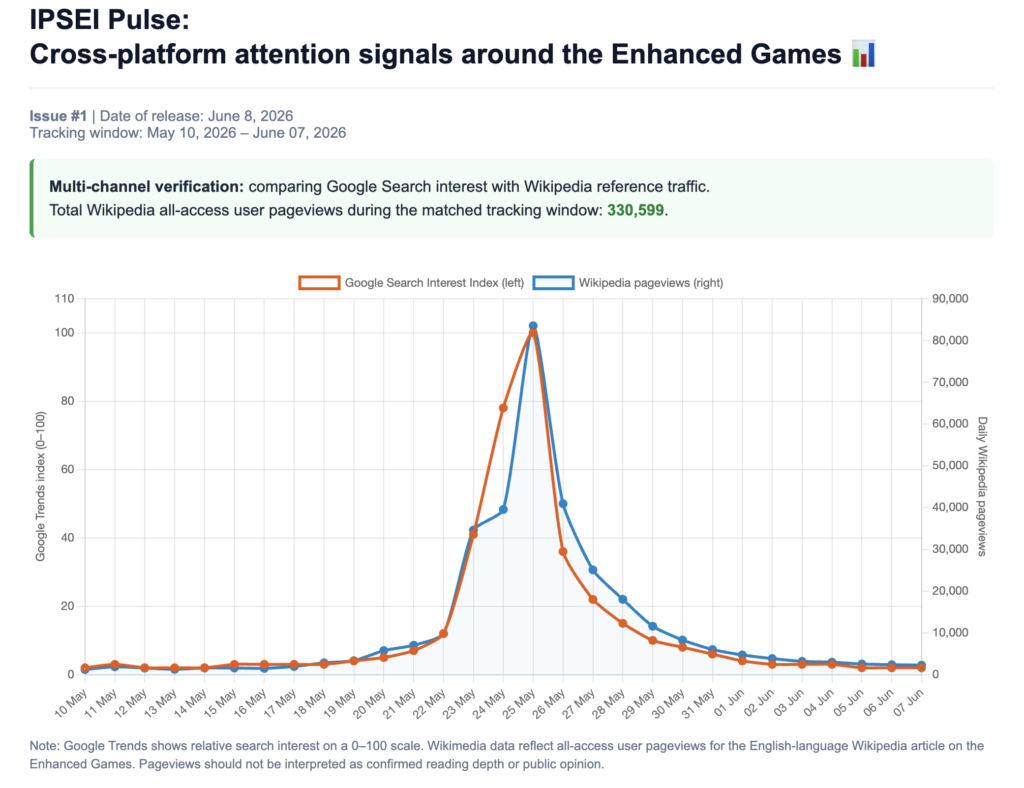
1. A sharp attention spike around May 23–25
For most of the tracking period, public search interest remained close to baseline level. This changed sharply from May 23, with the strongest attention signal recorded on May 25, 2026. Reference-based traffic followed a similar pattern, suggesting that public exposure to the topic quickly translated into information-seeking behaviour.
2. Search interest and reference traffic moved together
The simultaneous rise in both attention layers is notable. It suggests that TEG generated not only short-term search curiosity, but also a brief wave of users looking for more structured background information. During the matched tracking window, the relevant English-language reference page recorded 330,599 all-access user pageviews, with the highest daily volume reaching 83,501 pageviews on May 25, 2026. This does not prove support, opposition or sustained engagement. However, it does indicate that TEG generated a significant, time-concentrated wave of public curiosity.
3. The initial attention cycle declined quickly
After the May 25 peak, both attention layers declined rapidly. By the end of the tracking window, search activity had returned close to baseline level, while reference traffic had also fallen substantially from its peak. This suggests that the initial public attention cycle was intense, but short-lived.
Strategic takeaway
The cross-platform pattern suggests that public attention around TEG was highly concentrated within a short period. Search interest and reference traffic rose sharply at the same time, indicating that media exposure quickly translated into information-seeking behaviour.
For sport integrity stakeholders, this is a useful signal. Emerging sport concepts may generate immediate visibility, but their longer-term influence will likely depend on whether public debate moves beyond initial curiosity and engages more deeply with questions of athlete welfare, governance, ethics and the future meaning of sport.
IPSEI Pulse is a weekly analytical note by the International Platform for Sport Ethics & Integrity, tracking emerging signals across sport integrity, ethics, governance and public attention.
This analysis reflects IPSEI’s independent analytical perspective and is based on open digital attention indicators. It should not be interpreted as an institutional, regulatory or legal assessment.



Thank you for your rating!
Share your thoughts